Roman Empire in Canada? Archaeologist Emma Culligan Identifies “Time Capsule” Vault 140 Feet Beneath Oak Island
The history of North America is being rewritten 140 feet beneath the glacial till of Nova Scotia. In a development that has reportedly sent both researchers and production teams into a frenzy, archaeologist Emma Culligan is said to have identified what could be a sealed “time capsule” vault deep below Oak Island—one that may challenge everything we thought we knew about early transatlantic contact.

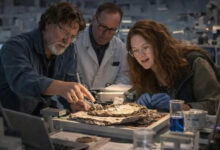
Culligan, known for her meticulous artifact analysis and scientific approach, reportedly made the breakthrough after reviewing a combination of high-resolution scan data and newly recovered material samples. According to early accounts, the anomaly appears not only structurally defined but also intentionally sealed—suggesting preservation rather than mere concealment.
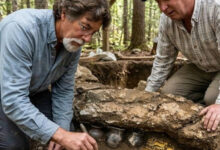
What makes this discovery truly explosive is the emerging theory tied to it. Preliminary interpretations of trace elements and markings on associated finds have led some to speculate about a possible Roman-era connection. While such claims remain highly controversial and unverified, the mere suggestion of Roman presence—or influence—in what is now Canada has ignited intense debate among historians and archaeologists alike.
At the center of the unfolding situation are Oak Island veterans Rick and Marty Lagina, whose long-running search has taken countless unexpected turns. Sources suggest that while both remain cautious, they recognize the potential magnitude of Culligan’s findings. If confirmed, this “vault” could represent not just hidden treasure, but a preserved snapshot of a previously unknown chapter of human history.

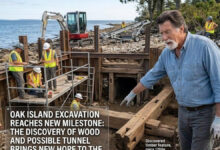
Engineers and specialists are now reportedly working to determine how to access the chamber without compromising its integrity. The depth—approximately 140 feet—combined with the unstable nature of the surrounding soil and the island’s infamous flood systems, makes any attempt extremely risky. One miscalculation could destroy whatever lies inside.
Skeptics, however, urge restraint. Many experts warn that Oak Island has a long history of misleading signals and overinterpreted data. Natural formations, combined with centuries of previous digging, can create anomalies that mimic man-made structures. Until physical entry and direct analysis are achieved, all theories remain speculative.
Still, the possibility alone is enough to capture global attention. A sealed vault. Ancient origins. And a mystery that refuses to be solved quietly.
If Emma Culligan is right, Oak Island may no longer be just a treasure hunt—it could be one of the most important archaeological discoveries of modern times.