SHOCK DISCOVERY on Oak Island: Emma Culligan Spots Mysterious Wooden Clues—Is Marty Lagina Finally Closing In on the Treasure?
The atmosphere inside the modest war room felt anything but ordinary. Around a simple wooden table, a small team of investigators leaned in, their attention fixed on two weathered wooden fragments laid out before them. What seemed like insignificant debris at first glance quickly became the center of an intense and potentially historic discussion—one that could reshape everything we know about the Oak Island mystery.

Among those present was Emma Culligan, whose sharp analytical instincts have recently made her a rising figure in the Oak Island investigations. Standing beside her, Marty Lagina observed the fragments with a measured but unmistakable curiosity. According to insiders, these pieces were recovered from a previously unexplored layer near the infamous Money Pit—an area long believed to conceal engineered flood tunnels dating back centuries.
Emma reportedly pointed out unusual tool markings on the wood, suggesting deliberate human craftsmanship rather than natural breakage. “This isn’t random,” she is said to have remarked, drawing attention to symmetrical cuts and signs of aging consistent with early maritime construction. Her observations immediately shifted the tone in the room—from cautious skepticism to cautious excitement.
Marty Lagina, known for balancing optimism with pragmatism, didn’t jump to conclusions. However, sources close to the team reveal that he acknowledged the potential significance of the find. If confirmed, these fragments could be part of an original structural system—possibly remnants of the elusive booby-trap mechanisms designed to protect whatever lies beneath Oak Island.

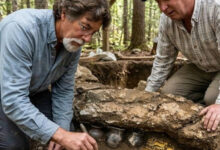


The presence of multiple team members, each bringing their expertise to the table, underscores how seriously this discovery is being taken. Engineers, historians, and material specialists are now reportedly working together to analyze the wood’s origin, age, and purpose. Early speculation hints at a connection to 17th or even 16th-century engineering techniques, which would dramatically expand the timeline of activity on the island.
What makes this moment particularly compelling is not just the objects themselves, but the reaction they provoked. For a team that has spent years chasing fragments of a puzzle, genuine excitement is rare—and meaningful. Emma Culligan’s growing role in these investigations adds another layer of intrigue, as her insights continue to challenge assumptions and open new avenues of exploration.
As the Oak Island mystery deepens once again, one thing is clear: even the smallest discoveries can carry enormous weight. And if Emma and Marty are right, these wooden fragments might be the quiet clue that finally leads to a very loud breakthrough.